Best Chair Yoga Moves for Better Sleep in Older Adults
If you want chair yoga for sleep to actually help, don’t start with a dramatic stretch. Start by getting settled. Sit toward the front half of a sturdy chair with both feet flat on the floor, about hip-width apart. Let your hands rest on your thighs. Then stack your ears over your shoulders and your shoulders over your hips. Nothing fancy. Just a position that lets your ribs soften instead of flare and your neck stop doing all the work. For many older adults, that simple reset is the first sign to the nervous system that the day is winding down.
From there, try three slow shoulder rolls back, then three forward. After that, gently nod the chin down and bring it back to neutral a few times, like you’re saying yes to sleep. Finish with a seated mountain pose: grow tall through the crown of your head while keeping your jaw loose and your belly easy. Hold for 5 slow breaths. Bedtime yoga for seniors works best when it feels steady and supported, not like exercise class at 8 p.m. The goal here is to remove tension, not prove flexibility.
Use a Seated Forward Fold to Quiet a Busy Mind
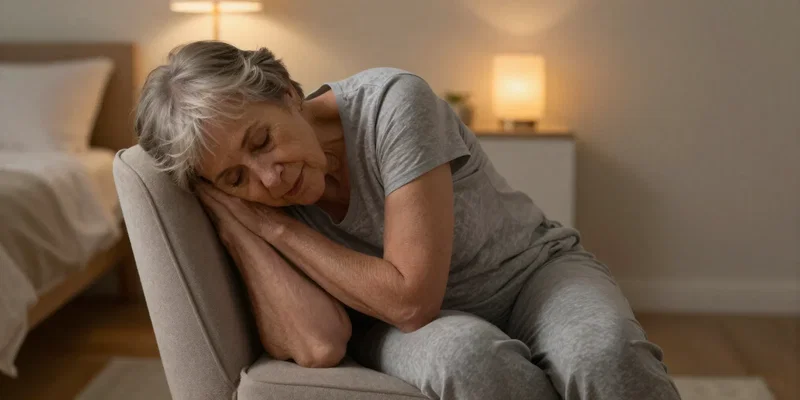
A seated forward fold is one of the best relaxation exercises for bedtime because it naturally turns the volume down. Sit with your feet planted and knees comfortably apart. Place your hands on your thighs and slowly hinge forward from the hips, only as far as feels easy. You can rest your forearms on your thighs, let your hands hang toward the floor, or place a pillow across your lap and fold onto that for more support. Let the head feel heavy. Not forced. Heavy.
Stay there for 5 to 8 breaths, and make the exhale a little longer than the inhale. That’s the secret sauce. A long, unhurried exhale helps shift the body away from that wired, restless feeling that shows up right when you finally get into bed. If your lower back feels tight, don’t chase depth. A small fold still works. Think of this move as a pressure release valve for the spine, shoulders, and mind. For older adults wellness, the best nighttime stretches are often the simplest ones done slowly enough to let the body catch up.
Loosen the Rib Cage With Side Bends and a Gentle Twist
When sleep feels out of reach, a tight rib cage is often part of the problem. Shallow breathing and stiff upper-body muscles keep the whole system a little too alert. A seated side bend can help. Sit tall, keep both feet grounded, and slide your right hand down the side of the chair while your left arm reaches up and over. Don’t collapse forward. Think long through the side waist. Take 3 to 5 slow breaths, then switch sides. The stretch should feel spacious, not sharp.
Next, add a gentle seated twist. Place your right hand on the outside of your left thigh and your left hand on the back or side of the chair. Rotate softly from the ribs, not by yanking with the arms. Hold for 3 breaths, return to center, and switch sides. This combination is especially good if you carry tension in the chest, upper back, or around the bra line and shoulder blades. It also helps bedtime yoga for seniors feel less sleepy-in-a-bad-way and more calming-in-a-good-way. You’re giving the body a little movement variety without waking it up.
Release Hips, Calves, and Ankles So Your Legs Stop Feeling Restless
Plenty of people blame poor sleep on their mind, but the legs can be just as guilty. Tight hips, cranky calves, and stiff ankles can leave you shifting around all night trying to get comfortable. Start with ankle circles. Lift one foot slightly off the floor and make 8 slow circles in each direction, then switch sides. After that, try a seated heel-toe rock: keep your heels down and lift the toes, then put the toes down and lift the heels. Go back and forth 8 to 10 times. It’s gentle, but it wakes up circulation without making you feel energized.
If it’s comfortable for your hips and knees, finish with a seated figure four stretch. Cross one ankle over the opposite knee or shin, depending on what your body allows. Sit tall first. Then, if it feels good, lean forward a little until you notice a stretch in the outer hip. Stay for 4 to 6 breaths and repeat on the other side. Skip this move if it causes knee discomfort. There’s no prize for pushing through. Good chair yoga for sleep should leave your lower body feeling warmer, heavier, and easier to settle under the covers.
End With Open-Hand Breathing That Makes You Want to Crawl Into Bed
The last part matters most. If you finish your routine with more stretching, you may miss the chance to let everything land. Sit comfortably with your hands resting on your thighs, palms up if that feels nice. Close your eyes or soften your gaze. Inhale through the nose for a count of 4, then exhale for a count of 6. Do that for 6 rounds. If counting feels annoying, just make the exhale slower and longer. That alone can make chair yoga for sleep far more effective.
Then add one final move: on the inhale, sweep your arms out just a little, like you’re widening the collarbones. On the exhale, bring the hands back down and imagine the weight of the day dropping off your shoulders. Small motion. No strain. If you want a simple bedtime routine, use this order: grounded seat, forward fold, side bend, twist, ankle work, hip stretch, long-exhale breathing. Ten to fifteen minutes is plenty. Done regularly, these relaxation exercises can become a real cue for sleep, the same way dim lights and a familiar blanket do. Not magic. Just a smart, repeatable habit that helps the body stop arguing with bedtime.